Blog / news
Startup and Idea Fest 2026 Showcases 100+ Nepali Startups
, 6 min read
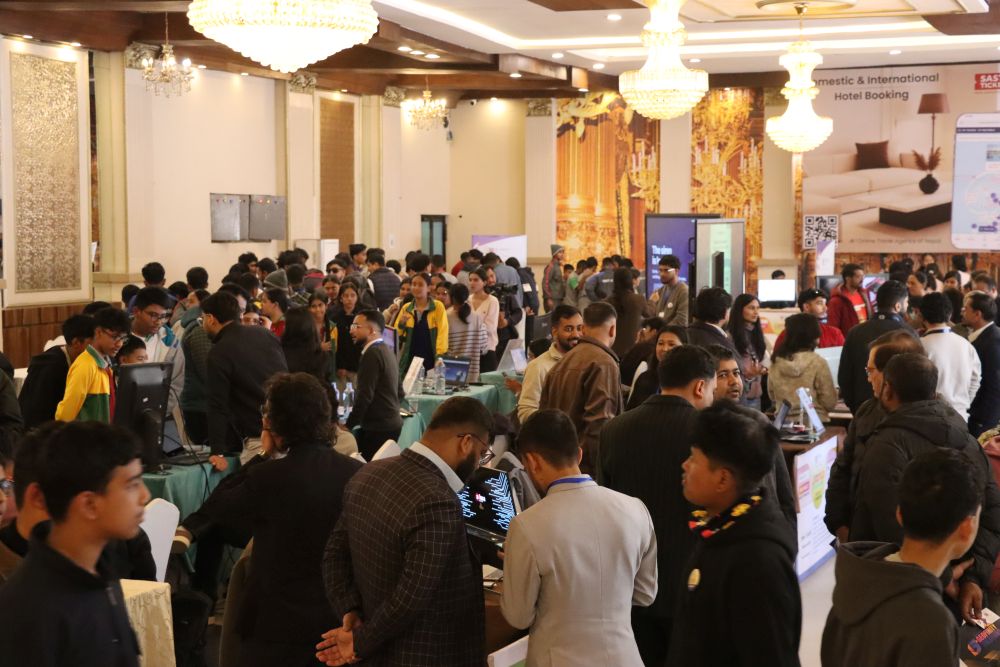
The seventh Startup and Idea Fest 2026 ran for two days, Mangsir 3 and 4 (November 2026), at Anupam Foodland in Battisputali, Kathmandu. More than 100 startups and innovation projects from all seven provinces showed their products and technology. Living with ICT, Squad of Changemakers and ICT Foundation organised it with Sunway AI College, and the fest served as the pre-event for the ICT Award 2026.
What happened
The exhibition spread across software, mobile applications, artificial intelligence, internet of things, robotics, drones and aerospace. Visitors could look at the products directly and ask teams about the local problems they were built to solve.
Prof. Dr. Sudhan Jha, a member of the National Planning Commission, was the chief guest. He said starting a startup is not the big achievement by itself, and that keeping one alive takes steady work, clear thinking and discipline. He also said the current generation of young people is more eager than earlier ones to try new work and move into entrepreneurship.
Rajan Lamsal, chair of the ICT Foundation, said the ICT Award began at the ICT Fest. In 11 years, he said, that effort has grown into a large programme that gives awards in several categories, with the aim of making Nepali technology, innovation and startups known internationally. Khushal Regmi, director of Sunway College Kathmandu, and Prof. Dr. Janardan Lamichhane, vice-chancellor of NAST, also took part.
On day one, Subash Sharma, a director at F1Soft, gave the keynote on "Building the Next Generation of Startups". He talked about new openings for startups, innovation, building entrepreneurship and tech-based businesses.
The launch that mattered most to builders was AstraCode, an AI code editor developed in Nepal. Its main feature is an AI agent that takes instructions in plain language and works from start to finish, and the launch report says it can test its own code and fix errors. AstraCode's team was the official AI tech partner of the fest, and at its stall developers, students and startup founders installed the editor on their own laptops and used it there.
A panel under Startup Conversations 2026 looked at "From Policy to Capital", chaired by Jha. The speakers were:
- Sanjay Poudel, chief advisor to the Minister of Science, Technology and Innovation
- Suman Pokharel, deputy chief executive officer at Global IME Bank
- Suman Shakya, founder of Tangent Waves
- Pankaj Jalan, chair of the Startup Committee at the Chamber of Commerce
Modnath Dhakal moderated. The discussion covered the policy settings startups need, the investment climate, incentive programmes and making it easier to reach capital from banks and financial institutions. Speakers also went into the problems founders face from the earliest stage through to expansion.
Two learning sessions ran on day one. Praveen Raj Joshi, a director at Roster Logic, spoke on "AI, Cyber Security and Frontier Tech for Startups", covering how startups can use AI and newer technology, why digital security matters and what technology can open up for a business. Ankur Sharma, a director at Innovation Leapfrog Technology Inc, gave a session titled "Non-Dev Tips for Building Software with AI".
Background
Startup and Idea Fest is a recurring event, not a one-off. This was the seventh edition, and its stated job is to put Nepali products, technology and business ideas on a single stage. The seven-province spread matters in a country where most tech events happen in Kathmandu, because it means teams from outside the capital get a room to show their work.
The timing is tied to the ICT Award. The fest is billed as a pre-event, so it works as a warm-up: startups meet the people who run the award, and the award gets visibility before its own programme. Lamsal's account puts the start of that award at the ICT Fest 11 years ago, which makes this pairing an old habit rather than a new idea.
AstraCode fits the pattern the fest is trying to sell. Nepal has plenty of people who use AI coding tools built elsewhere. A locally made AI code editor with an agent that follows plain-language instructions is a different claim: that the tool itself can be built here. The reports describe what it does, not how it performs against existing editors.
The event was a showcase and a talking shop. It was not a funding announcement, and neither report mentions investment deals, grants or valuations coming out of the two days.
Why it matters
For students and developers, the practical part was the stall. Being able to install AstraCode on your own laptop and run it beats watching a demo, and the reports say that is what happened. If you write code in Nepal, a local tool also means a local team to complain to when something breaks, though whether that support exists is not stated.
For founders, the "From Policy to Capital" panel put the people who write policy and the people who lend money in one room with the people who need both. A deputy CEO of a bank and an advisor to the science and technology minister on the same panel is the sort of pairing that rarely happens at a demo day.
For Nepal, the stated goal is international recognition for local tech, in Lamsal's words. One fest does not do that on its own. But 100+ projects from all seven provinces is a number worth repeating, because it shows the pipeline is wider than the Kathmandu bubble.
What the sources do not give: total visitor numbers, the size of any deals, or how many of the 100+ projects were full companies rather than student ideas.
What comes next
The next step named in the reports is the ICT Award 2026 itself, since the fest was its pre-event. No date for that main event appears in either report.
AstraCode has the bigger open questions. The reports do not say what it costs, which platforms it runs on, which programming languages it handles, or whether it is available outside Nepal. Its accuracy on real codebases is also untested in public, since the coverage describes the launch and the stall demos rather than benchmarks.
For the startups that exhibited, the follow-up is the usual one: whether the conversations at the stalls turn into pilots, customers or funding. Nothing on that is public yet.