Blog / news
XPENG WorldGPT Model Learns Across Cars, Robots and Drones
, 5 min read
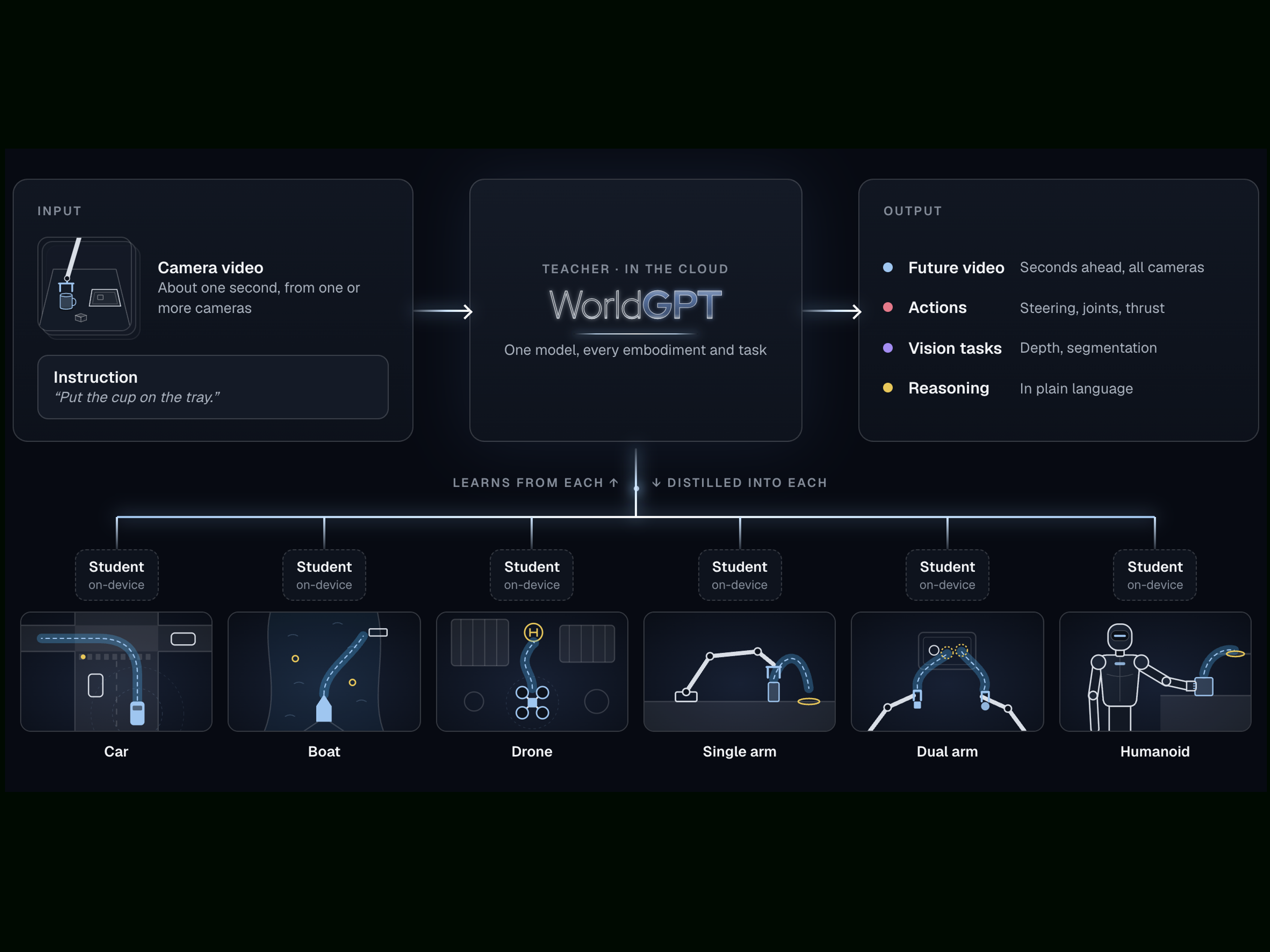
XPENG unveiled WorldGPT on November 24, 2026, a single AI model that the company says learns across six kinds of machines: cars, boats, drones, single-arm robots, dual-arm robots and humanoid robots. The XPENG WorldGPT model is part of the company's Turing World Model family, and XPENG claims 12 first-place results across public benchmarks in autonomous driving, robotics, visual understanding and video generation.
What happened
The announcement came out of Guangzhou, China, on November 24, 2026. XPENG describes WorldGPT as a world model built to help different kinds of machines understand, predict and interact with the physical world, rather than a system that only handles language.
The six machine types it covers:
- Cars
- Boats
- Drones
- Single-arm robots
- Dual-arm robots
- Humanoid robots
XPENG says WorldGPT is the first world model to show both prediction and action planning across all six. The model combines perception, reasoning, prediction and action planning. Given earlier camera footage and a simple instruction, it can generate a video of how a scene might develop, work out the actions needed to finish a task, and explain its reasoning in plain language. XPENG also says it can produce future video, actions, visual tasks and natural-language reasoning across different machines.
The training setup has two layers. A large cloud-based "teacher model" learns shared knowledge from data across the different machines. That knowledge is then distilled into smaller, specialised models designed to run directly on each machine.
The benchmark numbers are dated November 12, 2026. XPENG lists 12 first-place rankings spread over four areas: autonomous driving, robotic manipulation, visual understanding and video generation.
Background
Most AI in machines today is built one machine at a time. A car gets a perception and planning stack tuned for roads. A robotic arm gets a model tuned for picking things up. A drone gets something tuned for flight.
The problems overlap more than they first look. XPENG's own example: a car has to judge distances and anticipate the movements of surrounding vehicles, while a robotic arm has to identify an object's position and adjust its movements to pick it up. Both depend on understanding their surroundings, predicting what happens next and responding accordingly.
World models try to learn that general sense of the physical world once, then reuse it. XPENG frames WorldGPT as part of its Physical AI work, its term for AI that acts in the real world instead of only on text. The model sits inside the Turing World Model family, which the announcement names as the wider programme WorldGPT was developed under.
The interesting claim is about sharing, not just size. One model learns from six kinds of machines, so a lesson picked up from driving data can, in principle, help a robotic arm. That transfer is the part worth watching.
Why the XPENG WorldGPT model matters for developers
The usual path to putting AI on a new machine is expensive. Collect data for that machine, train a dedicated model, then adapt it to the hardware and to the way the machine moves. Then repeat the whole process for the next machine.
XPENG's pitch flips the order. Build a shared foundation in the cloud, distil it down for each machine, and spend engineering time on the specific task and hardware instead. The company says this approach could reduce development costs, improve data efficiency, and make it easier to extend physical AI capabilities to new types of machines.
The word to hold onto there is "could". The claim is about efficiency, and it is XPENG's own.
For a small team the difference would be practical. If you are building a single warehouse arm, training a world model from scratch is out of reach. Adapting something that already carries a sense of objects, motion and distance is a much smaller job. That is the argument. The benchmark results are the evidence XPENG puts behind it.
What comes next
XPENG describes a path where shared cloud knowledge is distilled into smaller models that run directly on individual machines. That distillation step is what would carry WorldGPT's learning into cars, robots and drones in the real world, and it is the part the announcement spends most of its detail on.
The benchmark figures give a fixed point to check against: 12 first places across autonomous driving, robotic manipulation, visual understanding and video generation, as of November 12, 2026. That is XPENG's own summary of its results.
Things to watch from here:
- Whether the distilled on-device models turn up in XPENG's shipping vehicles and robots.
- Whether the shared teacher model keeps improving as more machine types feed it data.
- Whether the four benchmark areas get expanded as the model family grows.
Until those distilled models are out in the world doing work, the 12 first places stay a company number. The approach is the story: one model, six kinds of machines, and a bet that learning how the physical world works is mostly the same problem whether you have wheels, rotors or arms.
Sources
- XPENG WorldGPT: One Model for Cars, Robots, Drones, xpeng.com, 2026-11-24